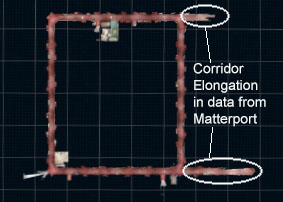
Matterport has become a popular solution for capturing spaces quickly—but speed doesn’t equal accuracy.

At Coast 2 Coast, we’ve tested Matterport extensively. And while it has its place, we often see it used in situations where it creates more problems than it solves.

The Reality Most Teams Discover Too Late

1. It Struggles in Large Spaces

Corridors stretch. Floors merge. Geometry drifts. The algorithm tolerates some inaccuracy, so errors accumulate over large spaces that chain data capture points.

2. It Doesn’t Scale

Since there is a 2,000-scan limit per tour, multiple models are required for large sites, which significantly increases hosting costs.

3. Measurements Can Be Misleading

You’re not measuring true point cloud data—you’re measuring a visual approximation. Significant errors occur if the object is too large, too small, or too shiny.

4. Your Data is NOT Yours

According to the terms and conditions, any data processed by Matterport is OWNED by Matterport. Your access—and your model—can disappear.


The Bottom Line

If your project decisions depend on the data—Matterport is often the wrong tool.
If accuracy, scale, and reliability matter—you need a different approach.

Where it Works

Matterport is a good fit for:

Small retail spaces
Marketing tours
Quick visual references

Where it Doesn't

Avoid it for:

Large commercial facilities
Complex renovations
Critical spaces like Airports and Hospitals
Any project requiring accuracy

Take the Quiz

Should You Use Matterport for Your Project?

Most teams choose the wrong capture technology—and don’t realize it until it’s too late.

A Better Approach

At Coast 2 Coast, we don’t push a tool—we design a solution.
As your as-built field-technology partner, we:

  • Deliver true point cloud data
  • Ensure accuracy at scale
  • Match the right technology to your project and give you full ownership
This website uses cookies and asks your personal data to enhance your browsing experience. We are committed to protecting your privacy and ensuring your data is handled in compliance with the General Data Protection Regulation (GDPR).